
Capture model
Pre-built component catalogues following GEFMA 300 and DIN 276 cost groups 300/400. Ready to use, configurable per asset.
From site survey to CapEx forecast in one file.
DOC.mobile TDD fully digitises Technical Due Diligence: condition assessment of real estate and industrial assets, structured building inspection, 10-year CapEx forecast, prioritised action plan. Whether acquisition due diligence, portfolio review or insurance valuation - audit-ready documentation without Excel chaos.
Every transaction, every portfolio review and every insurance revaluation faces the same question: what is the technical condition of the asset - and which investments are foreseeable? DOC.mobile Technical Due Diligence answers it in a structured way: with a capture model based on GEFMA 300 (cost accounting in facility management) and the GIF guidelines, a 1-to-5 grade-based Condition Assessment, CapEx forecasts over 1, 3, 5 and 10 years and a prioritised action plan. The building inspector goes on site with the tablet, documents component by component, photographs notable findings, estimates remaining service life and replacement cost - and the system aggregates the data into a finished TDD record automatically.
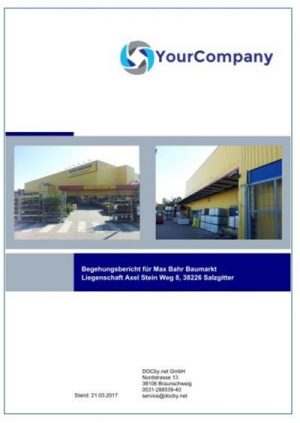
Whether acquisition due diligence under competitive pressure, periodic portfolio assessment or insurance revaluation after a claim: the capture model stays the same, only the analysis adapts. The TDD record can be sorted by components, rooms, trades, cost groups or action priority. At the press of a button you generate the classic TDD report in Word, an action plan in Excel or a JSON export for the asset management system (ISO 55001).
Asset managers, real-estate advisors, technical valuers and chartered surveyors: the methodology fits real estate, industrial assets, transport infrastructure and special-purpose buildings.
Pre-built component catalogues following GEFMA 300 and DIN 276 cost groups 300/400. Ready to use, configurable per asset.
Grades 1-5 with photo and note. Standardised across all building inspectors - comparable between assets.
Remaining service life × replacement cost = CapEx demand for 1, 3, 5 and 10 years. Inflation and discounting parametrisable.
From the findings the system generates a prioritised action catalogue: A (immediate), B (12 months), C (5 years).
Link findings directly to 360° photo capture. Visual evidence belongs in the TDD record.
Word, PDF, Excel or JSON. Your corporate design as a template - the report is rendered from the data at the press of a button.
As-built plans, tenant lists and technical data sheets are imported into the project. The capture model is loaded from a template.
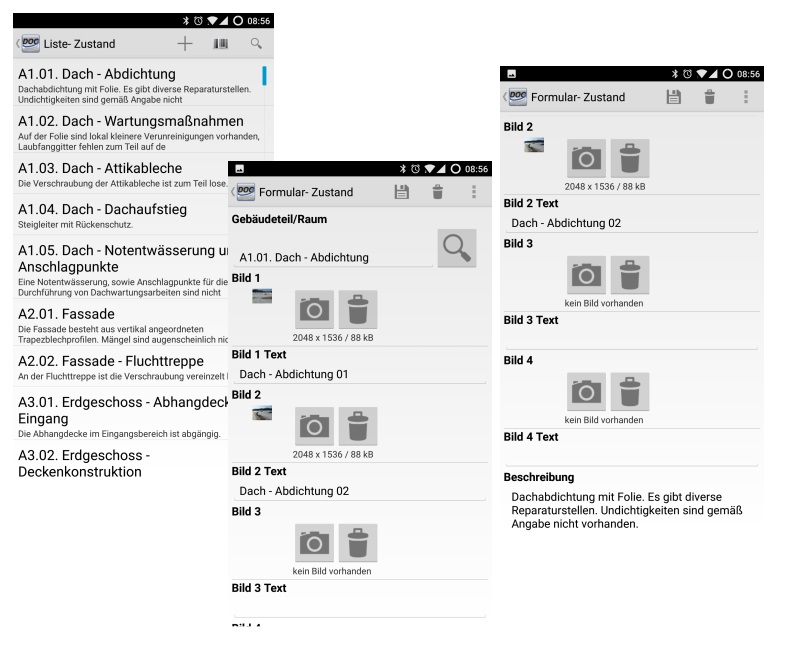
Tablet-based capture by rooms and components. Condition, photo, finding text by voice dictation. Works offline.
Cost and timing estimate per finding, automatic aggregation into the 10-year plan. Sensitivity for inflation/discounting.
Word report in your corporate design, Excel with actions, JSON for CAFM. Four-eyes principle via reviewer workflow.
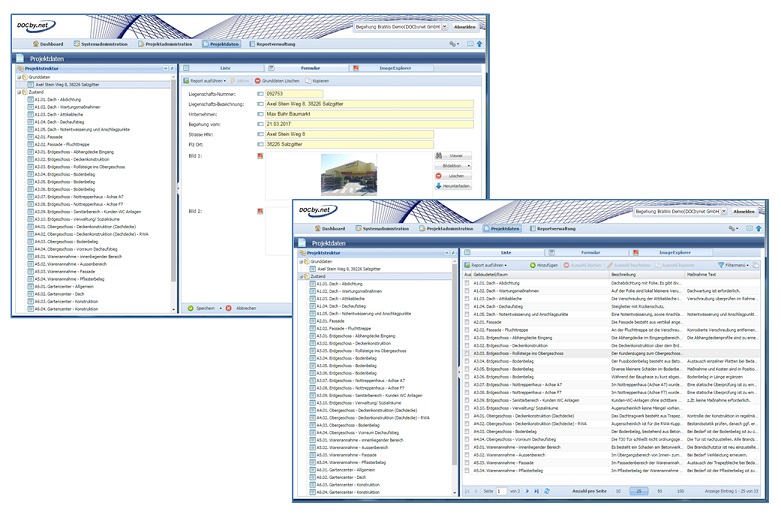
The building inspector records findings on the mobile device, the back office works on the same data in the web client - and the TDD report comes out at the end.
"DOCby.net is an innovative, open and service-oriented company that delivers a substantial time advantage and more transparency in the planning and construction process - to everyone involved in construction, especially management and the planning team."
Translated from the German original."With DOCby.net the handling and use of the required functions run smoothly; response times are quick and the administration is very good. Thanks to the central storage we save far less data and send far fewer e-mails, since data exchange runs via the server."
Translated from the German original.The standard data model follows GEFMA guideline 300 (cost accounting in facility management) and categorises along the cost groups 300/400 of DIN 276. For investor reports the GIF guidelines (Society of Property Researchers, Germany) on TDD in the valuation context are incorporated. For public-sector infrastructure inspections we work in line with DIN 1076.
Yes. Structured capture and a seamless lifecycle track for each component form the basis of a conforming asset management system under ISO 55000/55001. Findings, actions and CapEx paths can be handed over directly to common CAFM systems (Loy & Hutz, IMS-Ware, planon, Archibus).
For each component the system holds an average service life (source: VDI 2067, GEFMA 220); the inspector estimates the remaining service life from the actual finding, and the system derives the expected replacement date. Renewal costs are based on BKI benchmarks or your own historical data. Inflation and discounting are parametrisable.
Yes - in the PSE editor (Project Structure Editor) you extend component types, service lives, benchmarks and finding templates. You can also reuse project-specific catalogues from previous TDDs.
Yes, all captures work offline. Sync is automatic once the connection is back. Plans, component catalogues and previous findings are pre-loaded locally before the site walk.
You define detailed roles per project: capture, review, client, expert read-only. Multi-tenancy is standard - you can run multiple projects in parallel without data crossing over.
Specific templates for main, routine and special inspections on bridges, tunnels and retaining walls. Damage classes, structural and traffic safety assessment, plus SIB-Bauwerke-compliant export.
We will walk you through the entire TDD workflow on one of your own asset classes - with a live-generated report. Recommended pairing with 360° Photo Documentation for visual evidence. More background on the DOCby.net approach or get in touch directly.